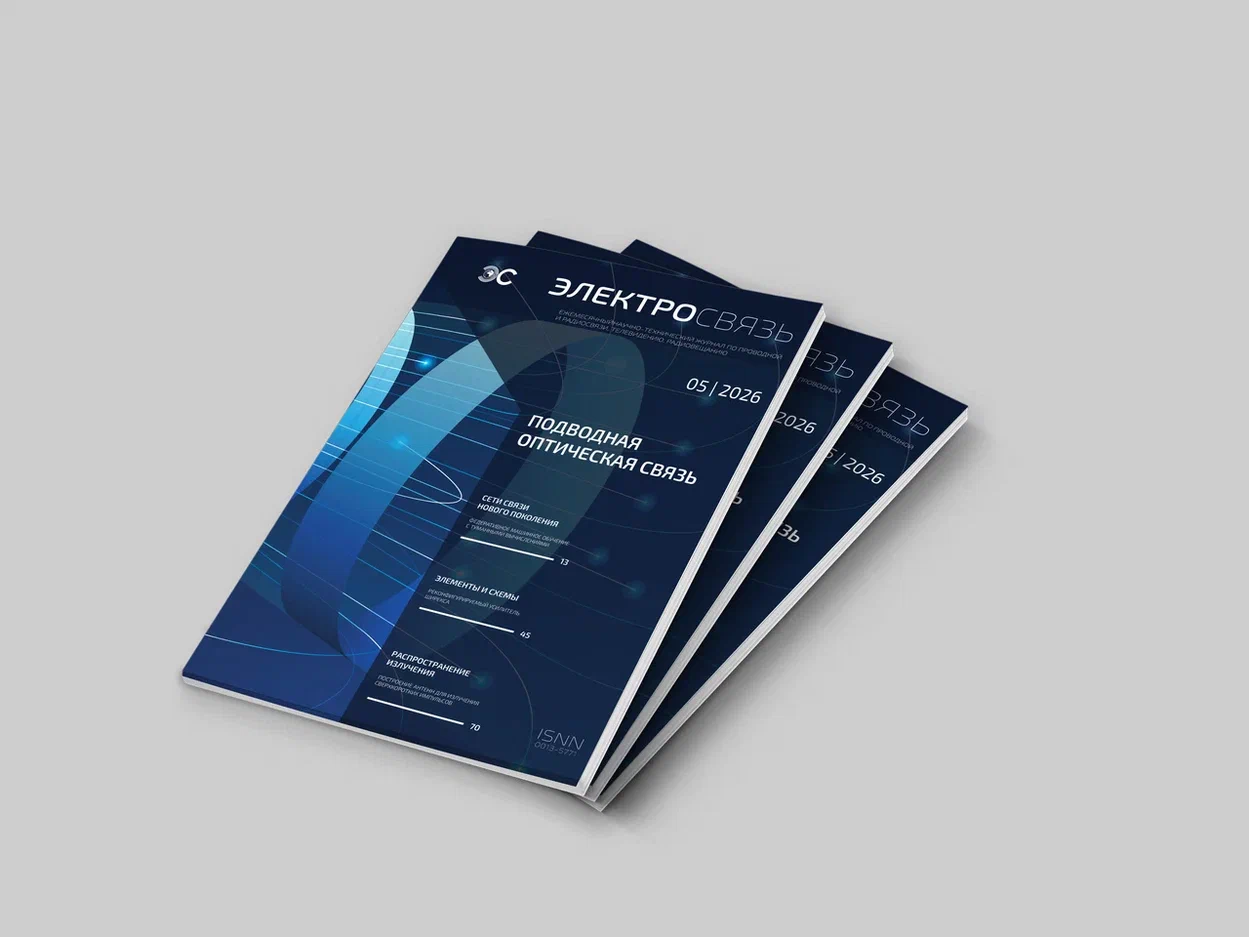
Items of № 5 — 2026
Achievements and development trends of wireless underwater optical communications
A.R. Shafieva, Moscow Technical University of Communications and Informatics (MTUCI), postgraduate; a.r.shafieva@mtuci.ru
P.A. Titovets, MTUCI, senior researcher, Ph.D.; p.a.titovets@mtuci.ru
M.O. Fedyuk, MTUCI, engineer; m.o.fedyuk@mtuci.ru
N.S. Bekushev, MTUCI, engineer; mnikolaysk@mail.ru
UDC 621.39
DOI: 10.34832/ELSV.2026.79.5.001
Abstract. A review of recent research in the field of underwater wireless optical communications conducted by foreign and domestic scientific teams is presented. Existing problems encountered by researchers when developing underwater wireless communications lines under various operating conditions are described. Approaches applicable to underwater wireless optical communications lines under various propagation environment parameters are described. Achievements in the field of underwater wireless optical communications capable of providing data transmission at speeds of up to tens of Gbit/s over distances of several meters are presented. Design solutions depending on the conditions and tasks of wireless underwater optical communications systems related to the choice of transmitter wavelengths, the number of transmitters, and their types are described. An important direction in the development of wireless underwater optical communication is the prospect of using groups of underwater and surface autonomous devices.
Keywords: underwater communications, wireless communications, high-speed communications, signal-code constructions, submersible vehicle.
For citation: Shafieva, A.R. Achievements and development trends of wireless underwater optical communications / A.R. Shafieva, P.A. Titovets, M.O. Fedyuk, N.S. Bekushev // Electrosvyaz. – 2026. – No. 5. – P. 2-12. (in russian)
Framework for federated machine learning with fog computing and a dynamic threshold-based user device sampling method
V.T. Dang, The Bonch-Bruevich Saint Petersburg State University of Telecommunications (SPbSUT), department of communication networks and data transmission, postgraduate; dangvanthang_sut@mail.ru
A.N. Volkov, SPbSUT, department of communication networks and data transmission, associate professor, Dr.Sci.(Tech.); artem.nv@sut.ru
UDC 621.391
DOI: 10.34832/ELSV.2026.79.5.002
Abstract. This paper proposes a framework integrating federated machine learning with fog computing, along with a user device sampling method based on a dynamic threshold of the loss function gradient change rate, adaptively computed at each training round using the mean and standard deviation of the gradient change rate across all participating devices. The effectiveness of the proposed solution is validated through simulations on the MNIST and CIFAR-10 datasets. The results demonstrate that the proposed method reduces the total communication volume between local model devices and the central server by up to 39% compared to the standard federated learning model, while maintaining the required convergence, training time, and model accuracy.
Keywords: federated machine learning, fog computing, user device sampling, dynamic threshold value.
For citation: Dang, V.T. Framework for federated machine learning with fog computing and a dynamic thresholdbased user device sampling method / V.T. Dang, A.N. Volkov // Electrosvyaz. – 2026. – No. 5 – P. 13-25. (in russian)
Identification, surveillance and command system for UAVs and assessment of C2 link requirements
V.R. Anpilogov, JSC VSAT-TEL, deputy director general, associate professor, Ph.D.; avr0505@yandex.ru
Yu.M. Urlichich, Russian Satellite Communications Company, advisor to the director general, professor, Dr.Sci.(Tech.); sdo@rscc.ru
V.K. Chan, Moscow Institute of Physics and Technology, postgraduate; cuong5911999@gmail.com
UDC 621.396.946
DOI: 10.34832/ELSV.2026.79.5.003
Abstract. The use of cellular networks – in conjunction with the GAIS ERA-GLONASS and 1090 MHz ADS-B systems – to ensure the safe operation of unmanned aerial vehicles is discouraged. It is noted that these technical solutions facilitate only the identification of UAVs, rather than their safe operational control. The structure of a prospective system for the identification, control, and command of UAVs is presented, designed to ensure their safe operation based on satellite technologies. An assessment is presented regarding the volume of transmitted information, as well as the requirements for the speed, reliability, and continuity of the C2 line. It is highlighted that the utilization of a low-Earth orbit satellite constellation represents the most rational technical approach for implementing a system to ensure safe UAV operations, particularly when compared to alternative solutions. Furthermore, it is noted that Russia possesses a substantial scientific and technical foundation for such a system, derived from design solutions developed for the «Marathon IoT» LEO constellation project, which incorporates LoRa technology and a modified LoRaWAN protocol. It has been noted that the proposed system not only ensures the safe operation of unmanned aerial vehicles but also can provide the full range of Internet of Things services.
Keywords: satellite system, unmanned aerial vehicles, C2 link, satellite communications.
For citation: Anpilogov, V.R. Identification, surveillance and command system for UAVs and assessment of C2 link requirements / V.R. Anpilogov, Yu.M. Urlichich, V.K. Chan // Electrosvyaz. – 2026. – No. 5. – P. 26-35. (in russian)
Differentiation of UAV signals and background sources in the 2.4 GHz band based on a set of spectral features
B.V. Bezsmertnyj, Novosibirsk State University of Architecture and Civil Engineering (NSUASE) (Sibstrin), senior lecturer; immortal@sibstrin.ru
P.A. Kovalev, NSUASE (Sibstrin), 3rd year student; p.kovalev@sibstrin.ru
I.I. Pavlov, NSUASE (Sibstrin), associate professor, Ph.D.; iipavlov02@mail.ru
UDC 621.396.96
DOI: 10.34832/ELSV.2026.79.5.004
Abstract. The subject of the research is methods of passive radio engineering differentiation of signals from unmanned aerial vehicles (UAVs) and background sources in the 2.4 GHz band in an intense electronic environment. The aim of the work is to develop and experimentally evaluate an integrated algorithm for detecting and classifying UAV signals based on combining energy criteria, cyclic prefix analysis of OFDM signals, and frequency switching analysis. The research methodology includes a spectral-temporal analysis of broadband recordings obtained using a software defined HackRF One receiver, frequency division of the range into fixed-width sub-bands, calculation of a set of diagnostic features and the formation of a decisive integration rule. Experimental testing of the algorithm was carried out on recordings of UAV signals, Wi-Fi signals, and ISM-band background sources. A statistical assessment of the probability of correct detection and the probability of false alarms was performed using the compiled set of experimental IQ recordings. It is shown that the integration of spectral features provides increased classification stability compared with the use of individual methods, especially in conditions of dense Wi-Fi traffic and multipath propagation. The results obtained can be used in the development of low-cost radio monitoring systems and preliminary detection of the presence of UAVs based on SDR platforms.
Keywords: UAV, radio monitoring, time–frequency analysis, radio signal detection, cyclic prefix, OFDM, FHSS, SDR, 2.4 GHz ISM band.
For citation: Bezsmertnyj, B.V. Differentiation of UAV signals and background sources in the 2.4 GHz band based on a set of spectral features / B.V. Bezsmertnyj, P.A. Kovalev, I.I. Pavlov // Electrosvyaz. – 2026. – No. 5. – P. 36-44. (in russian)
A reconfigurable Chireix amplifier based on class-e switching amplifiers for cellular communications
I.V. Komarov, Moscow Technical University of Communications and Informatics (MTUCI), postgraduate; ivk1406@mail.ru
S.F. Gorgadze, MTUCI, professor, Dr.Sci.(Tech.); s.f.gorgadze@mtuci.ru
UDC 621.396.61
DOI: 10.34832/ELSV.2026.79.5.005
Abstract. The operating principles and architecture of a Chireix power amplifier implemented in Class-E switching mode for multistandard radio transmitters are considered. Its basic structure is described, including transistor stages, broadband matching networks, and a Marchand transformer used as a broadband combiner. Reconfiguration options of the Chireix scheme with separate or joint design of the amplifier block and the combiner are presented, taking into account the influence of parasitic elements. Methods for controlling reactive elements (varactors and capacitor banks) are discussed. The operation of the Chireix amplifier under load modulation is analyzed, demonstrating the ability to maintain high efficiency over a wide range of output power levels, including reduced-power modes. It is shown that when the signal frequency changes, the high efficiency of the Chireix scheme can be preserved without retuning its circuits by adjusting the operating mode of Class-E amplifiers. Calculations confirm that the average efficiency of this scheme can reach up to 95% at a peak-to-average power ratio of 12–14 dB.
Keywords: power amplifier, outphasing, Chireix combiner, switching mode, Class E, energy efficiency, reconfigurable amplifier, broadband combiner, cellular communications.
For citation: Komarov, I.V. A reconfigurable Chireix amplifier based on class-e switching amplifiers for cellular communications / I.V. Komarov, S.F. Gorgadze // Electrosvyaz. – 2026. – No. 5. – P. 45-53. (in russian)
Federated deep reinforcement learning for network-based predictive edge computing in 6G mobile networks
H.A.Y. Yasir, The Bonch-Bruevich Saint Petersburg State University of Telecommunications (SPbSUT), department of communication networks and data transmission, postgraduate; yasir.hay@sut.ru
A.S.A. Muthanna, SPbSUT, department of communication networks and data transmission, professor, Dr.Sci.(Tech.); muthanna.asa@sut.ru
UDC 621.391
DOI: 10.34832/ELSV.2026.79.5.006
Abstract. This paper examines the use of Federated Deep Reinforcement Learning (FDRL) for network load optimization using edge computing in 6G mobile networks. In this work, the model assumes N=10 edge nodes, where each node will use FDRL agents (state space S=5, actions A=3) to determine the offloading/reallocation decision depending on the current and predicted load and resource characteristics. Local training of each FDRL agent is followed by aggregation of the model parameters on the server using the FDRL method, after which the updated global policy is distributed to the nodes. MATLAB simulations (E=100 episodes) show a reduction in the overall network load/latency from 363 ms to 117 ms (a reduction of 68%). These results demonstrate that FDRL can be used for adaptive offloading in 6G edge networks, given the low volumes of raw data transfer. This article explores the use of Federated Deep Reinforcement Learning (FDRL) to optimize network load using edge computing in 6G mobile networks.
Keywords: federated deep reinforcement learning, 6G networks, edge computing, network load, network optimization.
For citation: Yasir, H.A.Y. Federated deep reinforcement learning for network-based predictive edge computing in 6G mobile networks / H.A.Y. Yasir, A.S.A. Muthanna // Electrosvyaz. – 2026. – No. 5. – P. 54-60. (in russian)
Development of a simulation testbed for SDR equipment of regional multiplexing centers
V.L. Karyakin, Povolzhskiy State University of Telecommunications and Informatics, professor, Dr.Sci.(Tech.); vl@karyakin.ru
UDC 621.391
DOI: 10.34832/ELSV.2026.79.5.007
Abstract. A simulation testbed for SDR transmitters and a workstation designed for training a Graph Neural Network (GNN) in laboratory conditions has been developed, intended for use prior to the modernization of single-frequency networks (SFN) in broadcasting areas. The testbed is designed for the experimental evaluation of technical requirements for the equipment of regional multiplexing centers, the capital costs for project implementation [1], and the refinement of the software for its main components. Automated optimization of SDR transmitters, combining the reliability of a deterministic algorithm based on the DVB-T2 standard with the speed of adapting transmitter operating modes to changing broadcasting conditions, is ensured by the capabilities of the Graph Neural Network (GNN).
Keywords: regional multiplex forming center, SDR multiplex former, simulation testbed architecture, terrestrial SDR broadcasting, Graph Neural Network (GNN), DVB-T2 standard.
For citation: Karyakin, V.L. Development of a simulation testbed for SDR equipment of regional multiplexing centers / V.L. Karyakin // Electrosvyaz. – 2026. – No. 5. – P. 61-69. (in russian)
Analysis of antenna design options for ultra-short pulse radiation
K.O. Korovin, The Bonch-Bruevich Saint Petersburg State University of Telecommunications (SPbSUT), head of department, associate professor, Ph.D.; korovin.ko@sut.ru
P.A. Mezhevov, SPbSUT, senior lecturer; mezhevov.pa@sut.ru
A.G. Vladyko, SPbSUT, dean, associate professor, Ph.D.; vladyko@sut.ru
R.V. Kirichek, SPbSUT, rector, professor, Dr.Sci.(Tech.); kirichek@sut.ru
UDC 621.396.13
DOI: 10.34832/ELSV.2026.79.5.008
Abstract. This work is devoted to the analysis and calculation of design options for short ultra-wideband pulse radiators. The relevance of the work is due to the need to improve the radiation efficiency of short pulses for various applications, for example, to test the robustness of electronic equipment in complex interference environments. An analysis of the requirements for a selected pulse generator is carried out to ensure preservation of the pulse rise time and signal amplitude. Radiator options based on the Vivaldi antenna, an exponential horn, and a horn with combined excitation are considered. For the horn with combined excitation, optimization of the radiator dimensions is performed, and the radiation field for a given excitation pulse is calculated using electromagnetic simulation software. The calculation results show a significant increase in radiation efficiency compared to existing solutions.
Keywords: ultra-short pulses, radiation pattern, antenna, energy potential, radiation efficiency.
For citation: Korovin, K.O. Analysis of antenna design options for ultra-short pulse radiation / K.O. Korovin, P.A. Mezhevov, A.G. Vladyko, R.V. Kirichek // Electrosvyaz. – 2026. – No. 5. – P. 70-76. (in russian)
Synthesis of a filter compensator for dispersion distortions of broadband signals based on the frequency sampling method
K.H. Gallyamov, Moscow Technical University of Communications and Informatics (MTUCI), postgraduate; kamil.gallyamov.2000@mail.ru
E.M. Lobov, MTUCI, professor, associate professor, Dr.Sci.(Tech.); e.m.lobov@mtuci.ru
UDC 621.396.24
DOI: 10.34832/ELSV.2026.79.5.009
Abstract. Compensation of dispersion distortions of broadband signals in an ionospheric channel is investigated. Due to different phase delays, the spectral components of the signal arrive at the receiver with different group delays, resulting in a nonlinear dependence of delay on frequency. A polynomial model is used to describe the phase response. A frequency sampling method for finite impulse response (FIR) compensating filter synthesis with quadratic approximation of the response is proposed. The Gibbs effect is investigated, and the minimum number of FIR compensating filter coefficients is determined for different channel parameters, signal bandwidths, and sampling frequencies.
Keywords: radio communication, ionosphere, compensator, frequency sampling method, Gibbs effect, broadband signal, dispersion distortion.
For citation: Gallyamov, K.H. Synthesis of a filter compensator for dispersion distortions of broadband signals based on the frequency sampling method / K.H. Gallyamov, E.M. Lobov // Electrosvyaz. – 2026. – No. 5. – P. 77-88. (in russian)